

You come home after a long day in Dhaka’s traffic. You step inside your apartment — concrete walls, artificial lighting, closed windows, recycled air. Within minutes, the stress of the city follows you right through the door.
Now imagine something different. You walk in and immediately notice a wall of lush green plants. Natural light filters through sheer curtains. The furniture is warm wood. The air smells faintly of earth. Without doing anything at all, you feel your shoulders drop.
That is not a luxury fantasy. That is biophilic design — and it is one of the most important interior design movements of 2026.
In Bangladesh, where rapid urbanization has pushed millions into high-rise apartments with little connection to nature, biophilic interior design is no longer a trend for the elite. It is a practical, science-backed solution for anyone who wants a home that genuinely supports their mental and physical wellbeing.
In this complete guide, In-Art Studio will walk you through everything you need to know — what biophilic design is, why it matters specifically for Bangladeshi homes, which elements work best in our climate, how to apply it room by room, and what it costs. By the end, you will know exactly how to transform your home into a space where nature and modern living coexist beautifully.
What Is Biophilic Interior Design?
Biophilic design is the practice of incorporating natural elements into built environments — homes, offices, and public spaces — to strengthen the human connection with nature.
The word comes from “biophilia,” a term popularized by American biologist E.O. Wilson, which means the innate human need to connect with other living systems and nature. Simply put, humans evolved in nature over hundreds of thousands of years. Our bodies and minds are still wired to respond to natural light, organic textures, greenery, flowing water, and natural materials. When we spend all our time in environments devoid of these elements, our stress levels rise, our sleep suffers, and our mood deteriorates.
Biophilic design solves this by bringing nature back into our built spaces — not as decoration, but as a fundamental design principle.
It covers three main categories:
Nature in the Space — direct elements like indoor plants, water features, natural light, and fresh air.
Nature of the Space — spatial designs that mimic natural environments, such as curved forms, layered textures, and organic shapes.
Natural Analogues — materials and patterns that reference nature without being nature itself wood grain furniture, stone finishes, leaf-pattern textiles, bamboo screens.
Why Biophilic Design Matters for Bangladeshi Homes in 2026
Bangladesh is one of the most densely populated countries in the world. Dhaka, with over 22 million people, is one of the most densely packed megacities on the planet. Green space per person in Dhaka is critically low — far below the WHO recommended standard.
The result is a population that is increasingly disconnected from nature, spending the majority of waking hours in concrete buildings under fluorescent lights.
The consequences are measurable. Studies consistently show that people living in nature-poor environments experience higher rates of anxiety, poor sleep quality, reduced concentration, and lower overall life satisfaction. In Dhaka specifically, where commute times are long, pollution is high, and green public spaces are scarce, the home becomes the only environment a person can genuinely control.
This is why biophilic interior design is not a lifestyle trend for Bangladeshis — it is a genuine mental health and quality of life investment.
Beyond wellbeing, 2026 has seen a significant shift in how Bangladeshi homeowners think about interior design. The generic “showroom minimalist” look — white walls, glass surfaces, cold finishes — is rapidly giving way to warmer, more textured, more nature-connected interiors. Homeowners want spaces that feel alive, not staged.
Biophilic design answers this demand perfectly.
The 6 Core Elements of Biophilic Interior Design
1. Indoor Plants and Greenery
Plants are the most accessible and immediately impactful biophilic element. They improve air quality by absorbing carbon dioxide and releasing oxygen. They reduce cortisol levels — the primary stress hormone. Studies from the University of Exeter found that adding plants to a workspace increased productivity by 15 percent. Similar effects apply in home environments.
For Bangladeshi homes, plant selection matters. Not all plants thrive in Dhaka’s humid, hot climate with variable light conditions. The best performers are:
Snake Plant (Sansevieria) , nearly indestructible, thrives in low light, purifies air effectively. Ideal for bedrooms and corridors.
Peace Lily (Spathiphyllum) tolerates low light, produces white flowers, excellent air purifier. Great for living rooms.
Pothos (Money Plant) fast growing, trails beautifully from shelves and hangers, extremely low maintenance.
ZZ Plant (Zamioculcas) drought tolerant, glossy leaves, perfect for rooms with irregular watering.
Areca Palm adds tropical volume, natural humidifier, works well in corners of larger rooms.
Spider Plant compact, easy to propagate, ideal for small flats.
For placement, think in layers. Floor-level plants add groundedness. Mid-height plants on shelves or stands create visual interest. Hanging plants and ceiling-mounted planters draw the eye upward and make rooms feel taller.
A vertical garden wall even a small 3×4 foot panel creates an extraordinary visual impact and is increasingly feasible for Dhaka apartments using modular planting systems.
2. Natural Light Optimization
Light is perhaps the most powerful biophilic element, and one of the most underutilized in Bangladeshi apartment design.
Natural light regulates our circadian rhythm the internal biological clock that governs sleep, mood, digestion, and hormone production. Insufficient natural light is directly linked to depression, sleep disorders, and reduced immune function.
Most Dhaka apartments are designed with minimal attention to light flow. Windows are often small, corridors are dark, and rooms are arranged without consideration for how sunlight moves through the space during the day.
Biophilic design corrects this through several strategies:
Sheer curtains instead of heavy drapes allow diffused natural light to fill rooms while maintaining privacy particularly important in urban Dhaka.
Strategic mirror placement can effectively double the natural light in a room by reflecting it into darker corners. A large mirror opposite a window is one of the highest-impact, lowest-cost interventions in any apartment.
Light-colored walls and ceilings, warm whites, soft creams, and light sandy tones reflect natural light rather than absorbing it, making rooms feel brighter and larger.
Removing visual obstructions near windows tall furniture, heavy blinds, wall-mounted shelves blocking the glass frees up the flow of light into living areas.
Skylights are increasingly popular in duplex and rooftop apartments in Dhaka, providing overhead natural light that transforms otherwise dark spaces.
For artificial lighting, biophilic design recommends warm-toned LEDs (2700K–3000K) that mimic the warmth of natural sunlight rather than the harsh blue-white light of standard office-style bulbs. Layered lighting ambient, task, and accent with dimmer controls allows residents to shift the atmosphere of a room throughout the day, mimicking the natural transition from morning light to evening warmth.
3. Natural Materials Wood, Stone, Bamboo, Jute
The materials that surround us profoundly affect how we feel in a space. Synthetic materials, melamine boards, plastic laminates, PVC panels are visually and tactilely cold. Natural materials carry inherent warmth, texture, and organic variation that our brains respond to positively.
Wood is the cornerstone of biophilic material design. In Bangladeshi homes, wood furniture has always been valued, but biophilic design takes this further — exposed wooden beams, solid wood flooring, wooden wall panels, and furniture with visible grain all contribute to a deeply warm atmosphere. For sustainability and climate durability in Bangladesh, engineered wood and responsibly sourced teak or seguin are excellent choices.
Bamboo is one of Bangladesh’s most abundant and underutilized design materials. In contemporary interior design, bamboo is no longer associated only with rural settings. Refined bamboo screens, bamboo furniture frames, and bamboo ceiling panels create a sophisticated texture that is naturally suited to our climate. Bamboo handles humidity exceptionally well.
Jute another material deeply rooted in Bangladesh’s identity works beautifully in modern interiors as rugs, cushion covers, lamp shades, and wall hangings. A natural jute rug anchors a living room with warmth and organic texture that no synthetic rug can replicate.
Stone and terracotta add weight and earthiness. Stone feature walls, terracotta floor tiles, and ceramic accessories with raw, unglazed finishes bring the mineral world into domestic spaces.
Rattan and cane are experiencing a major global design revival. Rattan chairs, cane headboards, and woven storage baskets are simultaneously contemporary and deeply connected to the natural world.
4. Water Features
Water is one of the most psychologically powerful natural elements. The sound of moving water even very subtle measurably reduces cortisol and activates the parasympathetic nervous system, shifting us from stress response to calm.
For Bangladeshi apartments, large water features are not necessary. Small tabletop fountains, wall-mounted water panels, or even a simple indoor water garden create meaningful biophilic impact. The key is the sound and movement of water, not the scale.
For those with balconies, a small water feature integrated into the outdoor planting area creates a transition zone between the urban environment and the home a decompression space that signals to the body that it is safe to relax.
5. Natural Ventilation and Air Quality
Bangladesh’s climate hot, humid, with a distinct monsoon season presents unique challenges for interior ventilation. Many Dhaka apartments rely entirely on air conditioning, which while necessary in summer, creates a fully sealed, recycled-air environment that is physiologically stressful.
Biophilic design works with cross-ventilation principles positioning openings and furniture to allow natural airflow through apartments during cooler months. Ceiling fans with natural rattan or wooden blades maintain airflow aesthetically.
Indoor air quality is also dramatically improved by strategic plant placement. Certain plants snake plant, peace lily, spider plant are proven air purifiers that remove formaldehyde, benzene, and other VOCs commonly off-gassed by synthetic furniture and paints.
Natural, low-VOC paints and finishes increasingly available in Bangladesh further reduce indoor air pollutants, contributing to a genuinely healthier living environment.
6. Organic Forms and Natural Patterns
Nature very rarely produces straight lines. Biophilic design introduces organic curves, irregular forms, and nature-derived patterns into interiors to create subconscious comfort.
This can be as simple as choosing curved sofas over boxy ones, round dining tables over rectangular ones, or arched doorways over square frames. It extends to decorative choices cushions with leaf prints, rugs with flowing organic patterns, artwork featuring natural landscapes or botanical illustrations.
Fractal patterns patterns that repeat at different scales, as found in leaves, coastlines, and snowflakes are particularly calming. Wallpapers, textiles, and tile patterns featuring fractal-like designs are a sophisticated way to introduce this element.
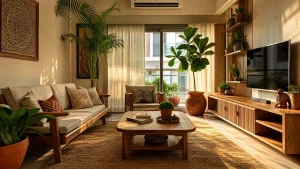
Room by Room How to Apply Biophilic Design in Your Bangladeshi Home
Living Room
The living room is the primary communal space and the most important room for biophilic intervention.
Start with a statement plant an areca palm or large fiddle leaf fig in a corner immediately anchors the space with living, breathing nature. Add a jute rug under the coffee table. Choose a wooden coffee table with visible grain over a glass or synthetic surface. Install warm LED lighting at 2700K on a dimmer.
For walls, consider a small vertical plant panel on one wall instead of a traditional art piece. Even 3–4 square feet of living wall creates an extraordinary focal point. Alternatively, a large piece of botanical artwork or a nature-inspired mural adds biophilic character without the maintenance.
Use natural textiles linen curtains, cotton or jute cushion covers, a cotton throw to replace synthetic fabrics throughout.
Bedroom
The bedroom is where biophilic design has its greatest measurable impact on wellbeing, directly affecting sleep quality, morning mood, and stress recovery.
Plants in the bedroom should be chosen carefully. Snake plants and peace lilies are ideal they release oxygen at night and are safe for enclosed sleeping spaces. Avoid plants that produce strong scents, which can disrupt sleep.
Natural light management is critical in the bedroom. Sheer curtains that allow morning light to gradually wake the body naturally mimicking sunrise support healthy circadian rhythm. Blackout capability for deeper sleep can be achieved with layered curtains rather than heavy single drapes.
Choose warm wood tones for furniture bed frame, nightstands, wardrobe. A wooden headboard with a simple, organic form immediately makes a bedroom feel grounded and warm. Natural fiber bedding cotton, linen completes the sensory experience.
A small tabletop water fountain on the nightstand creates gentle ambient sound that promotes sleep onset.
Kitchen and Dining Area
The kitchen benefits from biophilic design through herb gardens on windowsills — basil, mint, coriander, and other cooking herbs that are both functional and deeply satisfying to grow. A small wooden herb planter on the kitchen counter connects the act of cooking directly to living nature.
Natural stone or wood countertops, open wooden shelving, and terracotta or ceramic cookware displayed openly all contribute to a warm, organic kitchen atmosphere.
In the dining area, a central wooden dining table — solid, with visible grain — is the most important biophilic investment. Complement it with a natural fiber pendant light above (rattan or woven bamboo shades are excellent) and a small plant centerpiece.
Home Office
As work-from-home culture continues in Bangladesh post-pandemic, the home office has become a critical space for biophilic intervention.
Research consistently shows that natural elements in work environments improve focus, creativity, and reduce mental fatigue. A desk positioned near a window, with views of or direct access to natural light, is the single most impactful change.
Add a small plant cluster on the desk — succulents or a small pothos — for immediate visual relief during long work sessions. A wooden desk organizer and natural fiber desk mat replace synthetic equivalents without sacrificing function.
A small painting or photograph of a natural landscape — forest, ocean, mountains — provides micro-restorative moments during the workday when the eyes rest on it.
Balcony Your Biophilic Transition Zone
For Dhaka apartments, the balcony is an extraordinary biophilic opportunity that most residents underutilize.
Transform your balcony into a micro-garden. Use vertical planters along walls to maximize growing space. Install a small water feature a tabletop fountain or a simple water bowl with floating flowers. Add a small wooden bench or rattan chair with cushions. String warm Edison bulb lights overhead for the evening atmosphere.
This creates a genuine decompression zone, a transitional space between the urban city and the home interior that allows the nervous system to shift modes before entering the main living space.
The Science Behind Biophilic Design Why It Actually Works
In-Art Studio’s approach to interior design is science-backed we design for human biology, not just aesthetics. Here is the research behind biophilic design’s impact:
Stress reduction: A study published in the Journal of Physiological Anthropology found that interacting with indoor plants reduces psychological and physiological stress, as measured by cortisol levels and autonomic nervous system activity.
Improved sleep: Natural light exposure during the day and warm, dim light in the evening significantly improve sleep quality by supporting healthy melatonin production the hormone that regulates sleep.
Enhanced productivity and creativity: Research from the Human Spaces report found that employees in offices with natural elements reported 15 percent higher wellbeing and 6 percent more productivity. The same principles apply in home environments.
Faster recovery: Hospital studies famously showed that patients recovering in rooms with views of nature required fewer pain medications and recovered faster than those in rooms with wall views. This effect translates to residential environments.
Reduced anxiety: The fractal patterns found in nature tree branches, coastlines, leaf veining have been shown to reduce physiological stress markers by up to 60 percent when viewed, compared to non-fractal geometric patterns.
Biophilic Design for Bangladesh’s Climate Special Considerations
Bangladesh’s tropical monsoon climate presents specific design considerations that differ from biophilic design guides written for temperate Western climates.
Humidity management: High humidity in Dhaka, particularly during monsoon season (June–October), can be challenging for certain plants and natural materials. Choose humidity-tolerant plants tropical species naturally handle our conditions better than succulents or cacti. For wood, properly sealed and treated surfaces resist warping. Bamboo is naturally humidity-resistant and is an excellent material choice.
Heat management: Bangladesh’s summer heat (March–June) means natural ventilation alone is insufficient. Biophilic design works with air conditioning by ensuring that mechanical cooling is supplemented with natural elements that make spaces feel cooler psychologically green plants, natural materials, water features, and blue-green color palettes all create a perceived cooling effect.
Monsoon light: Bangladesh receives abundant natural light for most of the year, but monsoon season brings extended grey, overcast days. Warm artificial lighting during these months mimicking golden-hour sunlight at 2700K compensates for reduced natural light and prevents the seasonal mood dip that many Dhaka residents experience.
Air pollution: Dhaka’s air quality is consistently among the worst in the world. This makes indoor air quality interventions not just a wellness preference but a genuine health necessity. A strategic indoor plant arrangement combined with natural ventilation during lower-pollution hours (early morning) significantly improves the air residents breathe.
How Much Does Biophilic Interior Design Cost in Bangladesh?
One of the most important things to understand about biophilic design is that it does not require a large budget. It is a philosophy as much as a collection of products and its principles can be applied at almost any price point.
Budget tier (under BDT 30,000): This level focuses on plants, lighting, and small natural accessories. A collection of 8–10 indoor plants from Dhaka’s nurseries (Agargaon, Mirpur), a set of warm LED bulbs, a jute rug, and natural fiber cushion covers can dramatically transform a space.
Mid-range tier (BDT 30,000 – 2,00,000): At this level, natural material furniture enters the picture. A solid wood coffee table, a rattan accent chair, bamboo shelving, a quality wooden bed frame, and a small vertical garden panel create a genuinely transformed environment. Professional plant selection and arrangement services are also available in this range.
Premium tier (BDT 2,00,000 and above): Full professional biophilic interior design involves structural interventions — skylights, living walls, built-in water features, custom wood paneling, natural stone surfaces, and complete material specification across the home. In-Art Studio works at this level to create homes where every surface, material, and element has been chosen with both biophilic principles and the specific science of the client’s lifestyle in mind.
Biophilic Design vs. Regular Interior Design What’s the Difference?
Many people confuse biophilic design with simply “adding a few plants” to an otherwise conventional interior. The distinction is important.
Regular interior design treats plants and natural elements as decorative accessories additions to an already-conceived space.
Biophilic interior design starts with nature as the organizing principle. The question is not “where should we put a plant?” but rather “how does this space support the human biological need for nature, and what is the most effective way to meet that need through every design decision light, material, form, texture, sound, and air?”
The result is fundamentally different. A biophilic home does not look like a home that has been decorated with plants. It looks and feels like a home that has been built around nature — where the natural world is not an afterthought but the foundation.
How In-Art Studio Approaches Biophilic Interior Design
At In-Art Studio, we have been designing science-backed interiors in Bangladesh for over 5 years. Our approach to biophilic design is rooted in a simple principle: your home should actively support your health, not just look beautiful.
Every biophilic project we undertake begins with a detailed assessment of the space its natural light patterns throughout the day, its ventilation, its existing materials, and the lifestyle of the people who live in it. From this assessment, we develop a biophilic design strategy that is specific to that home and those people.
We do not apply a template. A biophilic bedroom for a family with young children looks different from one designed for a professional who works night shifts. The science is the same the application is always personalized.
Our team sources natural materials from both local Bangladeshi suppliers supporting local artisans and craftspeople and quality regional suppliers where local options are limited. We prioritize durability in Bangladesh’s climate, ensuring that every natural element we specify performs beautifully for years, not just months.
We have delivered biophilic-informed interiors across Dhaka from compact studio apartments in Mirpur to large family homes in Gulshan and the consistent feedback from our clients is the same: the space feels different. Not just better looking. Better to be in.
Frequently Asked Questions
What is biophilic interior design in simple terms? Biophilic interior design means designing your home to include natural elements plants, natural light, wood, stone, water, and organic textures in a deliberate, science-informed way, so that your home actively supports your physical and mental wellbeing.
Is biophilic design expensive in Bangladesh? No. Biophilic design can be implemented at any budget. Even BDT 20,000–30,000 spent on indoor plants, warm lighting, and natural fiber accessories can meaningfully transform a space. Full professional biophilic design is a larger investment, but the principles are accessible to anyone.
Which indoor plants are best for Dhaka apartments? Snake plant, peace lily, pothos, ZZ plant, areca palm, and spider plant are all excellent choices for Dhaka’s climate. They tolerate the heat and humidity, require relatively low maintenance, and provide measurable air quality benefits.
Can biophilic design work in a small apartment? Absolutely. In fact, small apartments often benefit most from biophilic interventions strategic mirror placement for light, vertical plant panels that use wall space rather than floor space, and natural material choices that make small spaces feel warmer and more expansive.
Does biophilic design work with Bangladesh’s climate? Yes, with the right plant and material choices. Tropical plants naturally thrive in our climate. Bamboo and jute are Bangladesh-native materials that perform beautifully in our humidity. The design simply needs to be calibrated for our specific conditions which is exactly what In-Art Studio does.
How is biophilic design different from just putting plants in a room? Biophilic design is a comprehensive approach where nature informs every design decision — light, material, form, ventilation, texture, and sound. Plants are one element within a larger system designed to meet the human biological need for connection with nature.
How long does a biophilic interior design project take with In-Art Studio? Project timelines vary based on scope. A room-level intervention typically takes 2–4 weeks from consultation to completion. A full-home biophilic design project typically takes 6–12 weeks.
Can I mix biophilic design with traditional Bangladeshi interior elements? Yes and this is one of the most exciting design directions for Bangladeshi homes in 2026. Nakshi Kantha, Jamdani textiles, terracotta pieces, and bamboo furniture are all deeply rooted in Bangladesh’s natural and cultural heritage, and they integrate beautifully within a biophilic design framework.
Ready to Bring Nature Into Your Home?
Biophilic interior design is not a trend that will pass. It is a return to something fundamental: the human need to live in connection with the natural world. In a city like Dhaka, where that connection has been largely severed by concrete and asphalt, your home is the one environment where you can restore it.
Whether you are starting with a few carefully chosen plants and a change in lighting, or you are ready to transform your entire home with a comprehensive biophilic interior design, In-Art Studio is here to help.
Our team of science-backed designers will assess your space, understand your lifestyle, and create a biophilic design strategy that is specific to you, beautiful, functional, and genuinely healthy to live in.
Book your free consultation today.
📞 Call us: 01681-917731 💬 WhatsApp: 01681-917731 🌐 Visit: in-artstudio.com 📍 Palton, Dhaka
Lorem ipsum dolor sit amet, consectetur adipiscing elit. Ut elit tellus, luctus nec ullamcorper mattis, pulvinar dapibus leo.